
The Maxwell School of Citizenship and Public Affairs at Syracuse University receives a large grant from the U.S. Department of Defense to run a program in National Security Studies (NSS). The Maxwell School boasts that its NSS program is the "Premier Professional Development and Training Program for the Defense Department." According to the NSS website, in the program "Senior Defense executives and senior military officers, entrusted with the responsibility of coordinating and implementing U.S. national security policy, are challenged to develop increasingly sophisticated management, leadership, and decision-making competencies" (http://www.nss.edu/Program.htm). Students in the course come to campus for several weeks where they are showered with gifts (fleece vests, field radios, pins, coffee mugs, golf tournaments, banquets) and instructed in the fine arts of management, case-study methodology, decision-making, war scenario development, pacification, and so forth. The course is met each year by protests by student and community activists, who find the University's links to the Defense Department to be abhorrent. In fact, this past fall, the head of NSS, Bill Smullen, called me into his office to try to get me to muzzle a student group I advise. He does not think protesting his program is legitimate. But he also knows he cannot win that fight on a university campus, at least not yet. A second strategy is to try to draw critics of the program into it. Smullen says instead of criticizing his program we should participate so that we can better see what they do and they can better learn why we are opposed to them. He told me in the fall that if we have criticisms we should bring them directly into the classroom so they can be contested by his students. In part for that reason, I was asked to prepare a presentation for one of the NSS classes. I was asked to come to the class to "give practical advice for the leaders of the Defense Department trying to plan for U.S. involvement in post-conflict societies." Below is the text of my remarks, presented on April 16, 2004, at the end of the bloodiest week so far in America's occupation of Iraq. The response was interesting. Bill Smullen was as mad as I had ever seen anyone and he told me that my remarks were completely inappropriate and had no place in a classroom. One of his colleagues, Bill Sullivan, who runs the Executive Education program within which the NSS is housed, thought it was exactly what was needed. An instructor in the Army War College has invited me to lecture to his students. A participant told me I was a piss-poor geographer.
A couple of months ago I was asked to participate in this forum. I was asked to spend a few minutes giving practical advice to you NSS students on issues related to U.S. involvement in "post-conflict societies." I am a professor of geography. My main areas of research focus on the ways that capital, labor and the state fight it out in the golden landscapes of California; by extension I am deeply interested in the geography of capitalism globally: that is, the geography of exploitation and oppression that, as much as freedom and a certain kind of liberty, is not incidental, but essential to capitalism. Another area of research is into contemporary cultural theory, working especially in the western Marxist tradition. A third area of research focuses on urban public space, particularly in the US but to some extent in Europe. In this third area I do research on homelessness, on protest in public space, and particularly on how the rights enshrined in the Bill of Rights, one of the most amazing documents ever to be written out of the ashes of a "post-conflict society," are practiced and policed on the streets of American cities.
So I am not sure why I was asked to talk to you—or what practical advice I can give you. Unless it is precisely this: I can be an example to you, something—or someone—you will confront in your efforts to occupy the world and make it do your bidding. I have no doubt you are a kind and loving person. Like me, you no doubt love your families. Like me, you might have any number of perfectly normal problems, perfectly normal interests, perfectly normal phobias, and perfectly normal perversions. Like me, you might care deeply about making the communities that you live in better, your lives more secure, your pursuit of happiness itself a deep well of happiness. Music might transport you, like me, to new worlds of understanding that exist somewhere beyond language, somewhere beyond ordinary emotion. Like me, in other words, you are human.
But I am probably also different than you. I find the construction of the American Empire to be utterly reprehensible. I find our diplomatic and military hypocrisy not only on the world stage but at home too to be abhorrent. I find our—that is my and your state's—role in the world, a role defined by the raw exercise of power, a startling ignorance of what other peoples are like and what they want, to be a sheer exercise not only in arrogance, but in violent bloody-mindedness. I find our reliance on force, on arms, on the technology of death, coupled with our disregard for others' lives—the thousands of Afghani civilians directly killed by our bombs as they missed Mohammed Omar and Osama bin Laden; the at least ten thousands Iraqis so far killed; the fifty to hundred thousand killed in Dresden; the more than a hundred thousand incinerated or condemned to a cancerous death in Hiroshima and Nagasaki; the two million Vietnamese—I find this disregard for other peoples' lives to be appallingly anti-human, appallingly anti- you-and-me. Bin Laden's tactics are the tactics of Hell. How, tell me how, ours are any different. He bombs cathedrals of commerce; we bomb Mosques, pharmaceutical factories, weddings, embassies, and whole villages that must be destroyed in order to be saved. But we profess to be the beacon and lovers of "freedom"—so on top of it all we are hypocrites
So I am probably different from you, because I doubt you see the world in these terms, for you are the bureaucrats of Empire: it is you, who, in whatever way large or small, are essential in creating a world I despise. I have no doubt that your motives are good. I have no doubt that your beliefs are true. You undoubtedly see security and patriotism and freedom and duty, where I see death and arrogance and the near-constant illegitimate use of power. So maybe I am different from you. But I am not different from the rest of the world. In fact, I am likely right in line with the majority. And that is my practical message to you: there are a lot of us out there.
Consider the 12 year old—twelve year old—Korean boy I met on a train from Taegu to Seoul in August 2000. He wanted to practice his English. He was a funny kid, I enjoyed talking to him about baseball, about geography (which he studied in school), about Disneyland, about being a kid in Pusan, where he was from. But at one point in the conversation he stopped, got serious and said: "I like you Americans. You can be really nice. But you have to leave—not you [speaking about me]—but your Army. They kill. They make us unsafe. They rape." Or consider the college students I met the following April in Osaka, who wanted to talk to me about my ideas about culture, and about public space in America, but also, when we got to the bar, stopped, got serious again, and gave me a history lesson in American atrocities in Okinawa and wanted me to go home and tell everyone I could about the American occupation of the islands. Or consider Nico, the owner of an Osteria in a small Abruzzese village. He befriended us, cooked for us and wouldn't let us pay, and stood us to drinks. And each night for a week in June, 2003 he and his village friends, in their broken English, would gather to tell us how arrogant our country was, what a folly its war in Iraq was, what a mess we were making of a world that could be so beautiful. Consider the protests against Subic Bay, against Vieques, even against the Navy's intermittent presence in Tromsÿ. And these are all allies.
Consider the millions of people in the largest mass demonstration in the history of the world who took to the streets in February 2003 to tell their governments—since ours was a lost cause—to oppose our adventurism in Iraq.
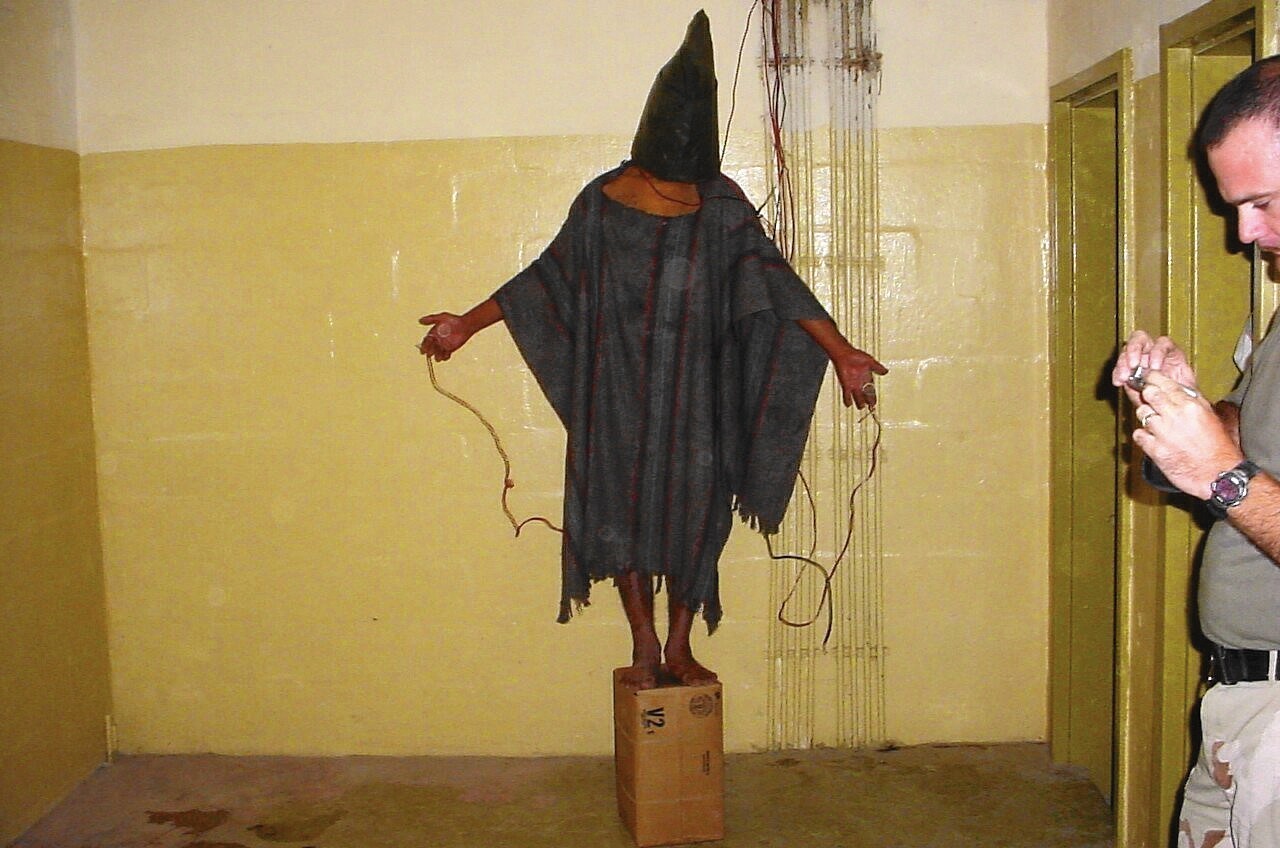
All these people—around the world, from Mumbai to Milan, from Bangkok to Berlin, from Cape Town to Copenhagen, and from Lima to Lisbon—don't hate us. They often quite like us. But they do, utterly and rationally, fear us. And they are not ignorant. They know about our Bill of Rights (I know I talk to them about it), they know our great history of creativity, they want to come see Monument Valley, Greenwich Village, and the Golden Gate Bridge, they want to listen to John Coltrane and Eminem and Waylon Jennings; they await the next Coen Brothers film as eagerly as we do. But they also know about our role in Pinochet's coup against Allende and the Shah's against Mossedegh; about our role in the Columbian war of attrition, and in propping up and then taking down Noriega; they know about our appalling actions, over more than fifty years now, in Haiti, our support for Savimbi, and our bizarre support for Pol Pot and the Khmer Rouge. They know about our mining the harbors of Nicaragua and our war against democracy in Central America. And they know that we will prop up any number of other petty tyrants including Saddam Hussein himself if it serves our interests (or even our whims). They know about our power and our unabashed desire to use it, no matter what the consequences, no matter what the alternatives. They are smart, they are historically aware, they are appalled, and they are afraid. They do not trust us—they do not trust you—for a minute.
You might be here, in this seat, with the job that you have, for any number of reasons. I can't know what they all might be. You probably do your job very well. But that job, from my perspective, means that you are part of that machine of death. That illegitimate use of power. That system of domination and oppression.
It might equally be that I am completely wrong. But this is what I believe and in believing it, I am like millions—probably billions—of others around the world. We are the people who live in "post-conflict" societies. And if we do not live there, then we live in ones that we fear are pre-conflict. And if we live here, in America, we know we live in a constant state of conflict—a state of war that has lasted a century now. With every fiber of our beings we want something different.
And so this is my practical advice to you: it is us that you will meet in the streets of any post-conflict society: it is me—me and my brothers and sisters, who will be on the street. We will be protesting, struggling, seeking to make something new out of the old that you have rendered to ashes. Remember that. Remember when you are hoping to pacify the streets of Tehran or Taipei or Tunis that you are trying to pacify me, if not me personally, than what I stand for. Remember that in the streets and parks and other public spaces of the city that at least a significant minority, and quite possibly a majority resent if not you personally, then what you stand for. And as you remember that, maybe you will remember this:
That most amazing document ever to come out of the ashes of a post conflict society—the Bill of Right—is the best testimony there is to the good that can come not from the making of an empire, but its defeat. Think about it. Almost every one of those rights is a cry against the abuses of Empire, a loud testimony to how a people learned to say never again: never again will we be occupied by the Army of Empire. That's what the Third Amendment says. Never again will we let someone else have a monopoly on the use of fire-power. We'll keep our guns. Never again will we let them take our property, shut down our presses, hold us without charge or without bail, kill us without trial. These are rights we won and that we claimed. They were not granted—in an interim constitution or otherwise—they were taken. They were invented precisely as a dance of victory over a vanquished Imperial power.
Now—and this saddens me more than I can say—the whole world is looking to make that joyous dance over us: for we are that Empire that must be told never again. We are the ones holding people without charge, bail or trial. It is us who are confiscating property and billeting soldiers not in individual homes now, but whole towns, whole countries. It is us who kill without trial. It is us who, in the words of the Ninth Amendment, now "disparage" and "deny" the rights of the peoples of the world.
So remember that, you who are the bureaucrats of Empire: remember that the people in so-called post conflict societies are people just like me. Remember that when you build your bases, provision your occupying troops, fence off whole sections of cities in hopes of keeping yourselves safe, order your next shipment of cluster bombs. What we—the people—want is precisely that which you the Empire have come to stand against. That's my practical advice in a word: "Remember who we are."